Next intakes — 200 Hr: 21 Jul · 300 Hr: 13 Aug · 500 Hr: 21 Jul 2026 View all dates

Our spiritual inspiration

India's spiritual masters, and the teachings we study at the ashram

Every yoga philosophy class at Rishikesh Yogpeeth goes back to a small circle of teachers. These are the spiritual gurus of India whose books we read, whose verses we chant and whose methods we practise, from the sage of the Bhagavad Gita to the author of Light on Yoga.

  • Six masters, one tradition
  • Over 2,000 years of teaching
  • Yoga Alliance RYS 200 · 300 · 500
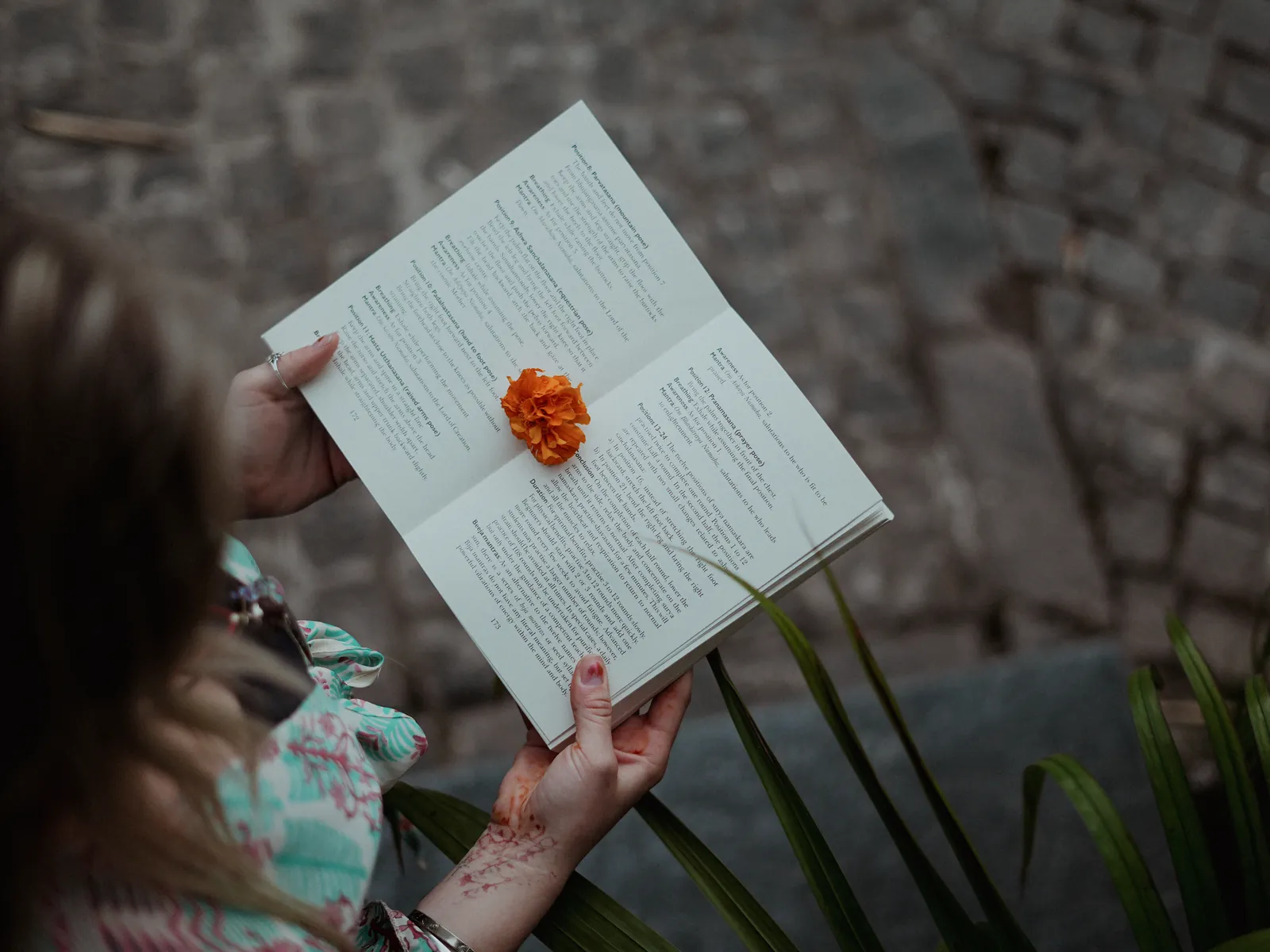
A student holds open a yoga text with a marigold resting on the page at the ashram in Rishikesh
Study at the ashram begins with the texts
Portrait slot · Traditional painting or temple sculpture of Veda Vyasa (often shown dictating the Mahabharata to Ganesha). Public-domain artwork only. Export 800×1000 as master-vyasa.webp

01Sage of the Mahabharata and the Bhagavad Gita

Maharishi Vyasa

Ancient sageThe Gita is dated by most scholars to between the 5th and 2nd centuries BCE

Indian tradition honours Veda Vyasa as the sage who arranged the Vedas and composed the Mahabharata, the great epic that contains the Bhagavad Gita. Guru Purnima, the full-moon day on which India honours its teachers, is also kept as Vyasa Purnima in his name.

Tradition also gives his name to the Yoga Bhashya, the oldest surviving commentary on Patanjali's Yoga Sutras. Scholars still debate who wrote it, but students of the Sutras have read them through it for well over a thousand years.
Portrait slot · Classical statue or painting of Patanjali (serpent hood, hands in anjali mudra). Photograph a statue yourselves, or use public-domain artwork. Export 800×1000 as master-patanjali.webp

02Compiler of the Yoga Sutras

Maharishi Patanjali

c. 2nd century BCE – 5th century CEScholars disagree on the date; many now place the Sutras around the 4th century CE

Almost nothing is known for certain about Patanjali's life. Tradition holds him to be an incarnation of Adishesha, the serpent on which Vishnu rests, which is why statues show him with a serpent's hood above his head.

What has come down to us is his text: the earliest surviving systematic account of yoga as a discipline of the mind, so concise that it has drawn commentaries for more than fifteen centuries, from Vyasa to Vivekananda and Iyengar.

Portrait slot · No portrait of Swatmarama exists. Use a manuscript page of the Hatha Yoga Pradipika (public domain), or a Nath-tradition painting. Export 800×1000 as master-swatmarama.webp

03Author of the Hatha Yoga Pradipika

Swami Swatmarama

15th century CEDated by scholars to around the 15th century

Swatmarama was a yogi of the Nath tradition. He opens his book by naming the masters before him, from Adinatha (Shiva) to Matsyendranath and Gorakhnath, and presents Hatha Yoga as a stairway to Raja Yoga, the yoga of the mind described by Patanjali.

The Hatha Yoga Pradipika gathered older teachings into one practical manual, and it remains the best-known classical text on Hatha Yoga, the tradition Rishikesh Yogpeeth teaches.

Portrait slot · Photograph of Swami Vivekananda, e.g. the Chicago 1893 portraits (public domain). Check the source scan is free to reuse. Export 800×1000 as master-vivekananda.webp

04The teacher who brought Raja Yoga to the West

Swami Vivekananda

1863 – 1902Born in Calcutta (Kolkata); died at Belur Math

Born Narendranath Datta in Calcutta on 12 January 1863, he became the foremost disciple of the mystic Sri Ramakrishna. His address to the World's Parliament of Religions in Chicago in September 1893 made him one of the first teachers of Vedanta and yoga to reach a wide Western audience.

He founded the Ramakrishna Mission in 1897 and died at Belur Math in 1902, aged 39. India marks his birthday every year as National Youth Day.

Portrait slot · Photograph of Swami Sivananda. Request permission and a credit line from the Divine Life Society, Rishikesh. Export 800×1000 as master-sivananda.webp

05The sage of Rishikesh

Swami Sivananda Saraswati

1887 – 1963Taught in Rishikesh from 1924 until his death

Born Kuppuswami in Pattamadai, Tamil Nadu, on 8 September 1887, he practised as a doctor in Malaya before leaving medicine for the spiritual life. He came to Rishikesh, took sannyasa here in 1924, and in 1936 founded the Divine Life Society on the banks of the Ganga, where he taught until 1963.

His disciples carried yoga around the world. Among them were Swami Vishnudevananda, Swami Satyananda Saraswati, founder of the Bihar School of Yoga, and Swami Satchidananda.

Portrait slot · Photograph of B.K.S. Iyengar. Still under copyright: license one (RIMYI, Pune, or a photo agency) and print the credit. Export 800×1000 as master-iyengar.webp

06Author of Light on Yoga

B.K.S. Iyengar

1918 – 2014Born in Bellur, Karnataka; taught in Pune

Bellur Krishnamachar Sundararaja Iyengar was a sickly child when he began learning yoga in 1934 from his brother-in-law, T. Krishnamacharya, in Mysore. He settled in Pune, where he taught for more than seven decades and opened the Ramamani Iyengar Memorial Yoga Institute in 1975.

TIME named him one of the 100 most influential people in the world in 2004, and India awarded him the Padma Shri, Padma Bhushan and Padma Vibhushan. He died in Pune on 20 August 2014, aged 95.

Film: a yoga philosophy class at the ashram

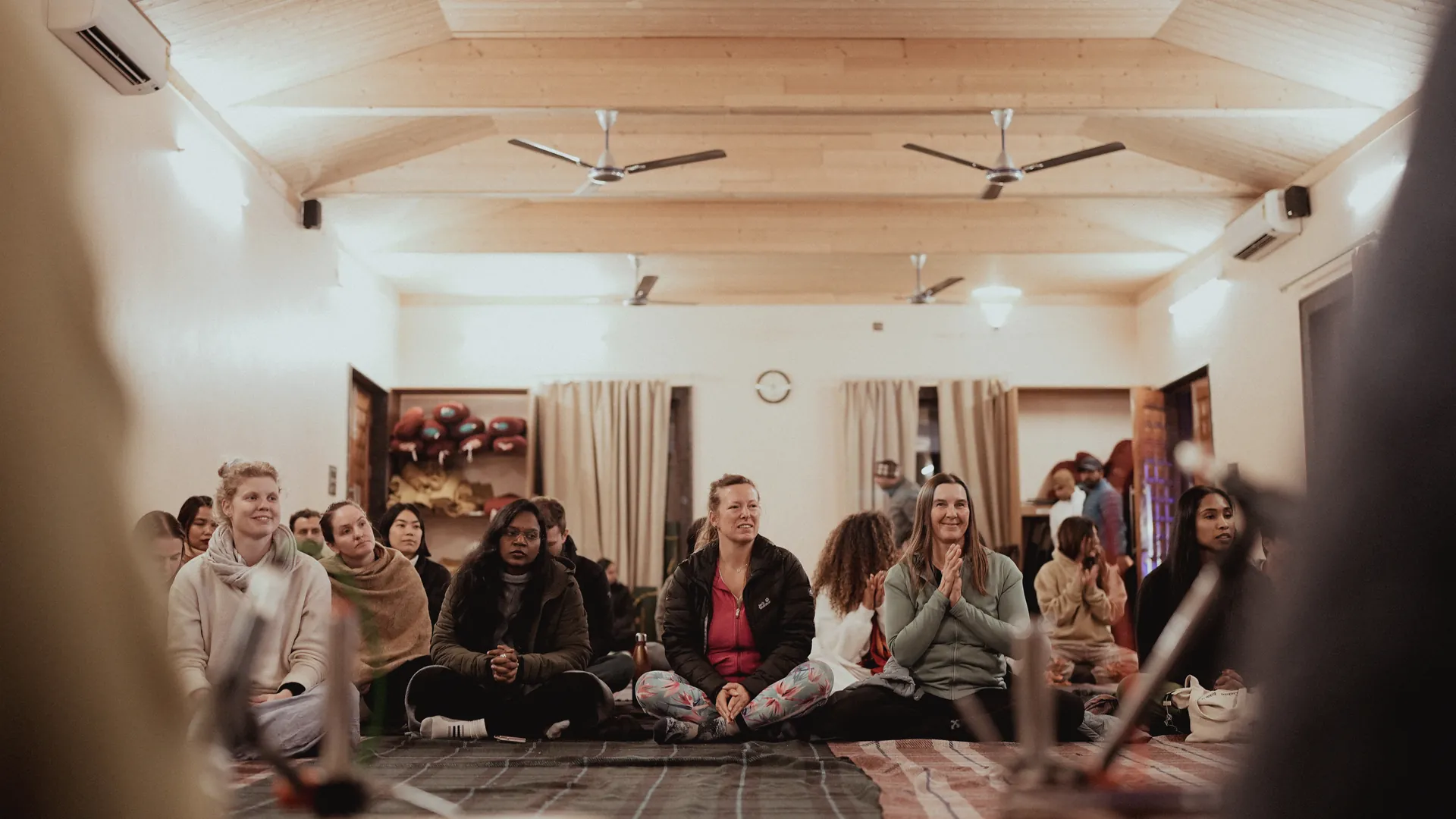
Students seated in a circle on the floor of the yoga hall during a satsang at the ashram in Rishikesh
Inside a yoga philosophy class at the ashram Philosophy class film, 60 to 90 seconds, 16:9: a teacher reading a sutra aloud in Sanskrit, students repeating it, then the discussion that follows. Natural sound, burned-in subtitles.

In your course

How the masters' teachings come together at the ashram

You will not study these teachers one after another like chapters in a history book. Their ideas meet every day, in the philosophy hall, on the mat and in the rhythm of ashram life.

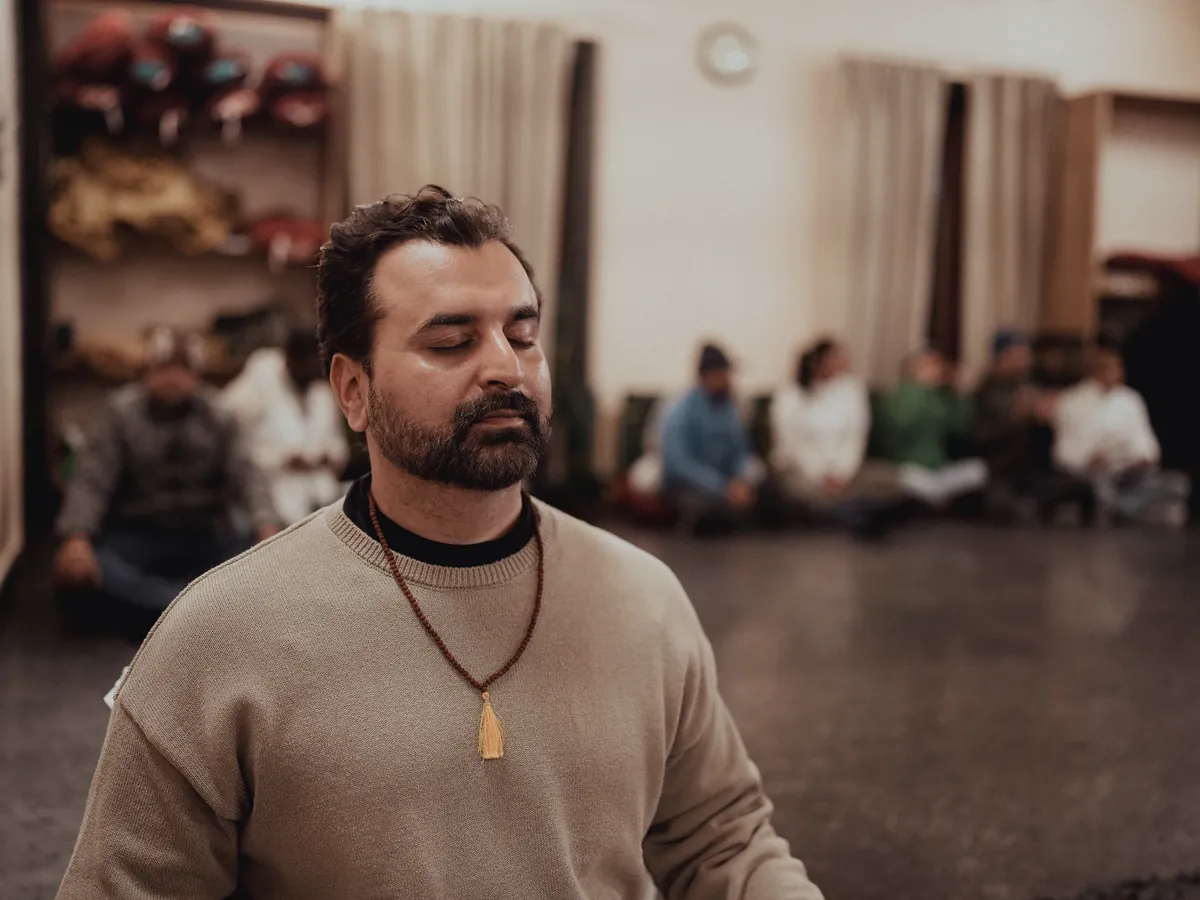
A teacher wearing rudraksha beads sits in meditation in front of students in the yoga hall

In philosophy class

Sutra by sutra and verse by verse, with Sanskrit terms explained and time to discuss how each idea applies to a modern life.

On the mat

Hatha Yoga as the Pradipika describes it, from shatkarma to pranayama, practised with the precision Iyengar taught.

In ashram life

Seva, kirtan, satsang and silence: the Yoga of Synthesis lived from the 5:30 bell to lights out.

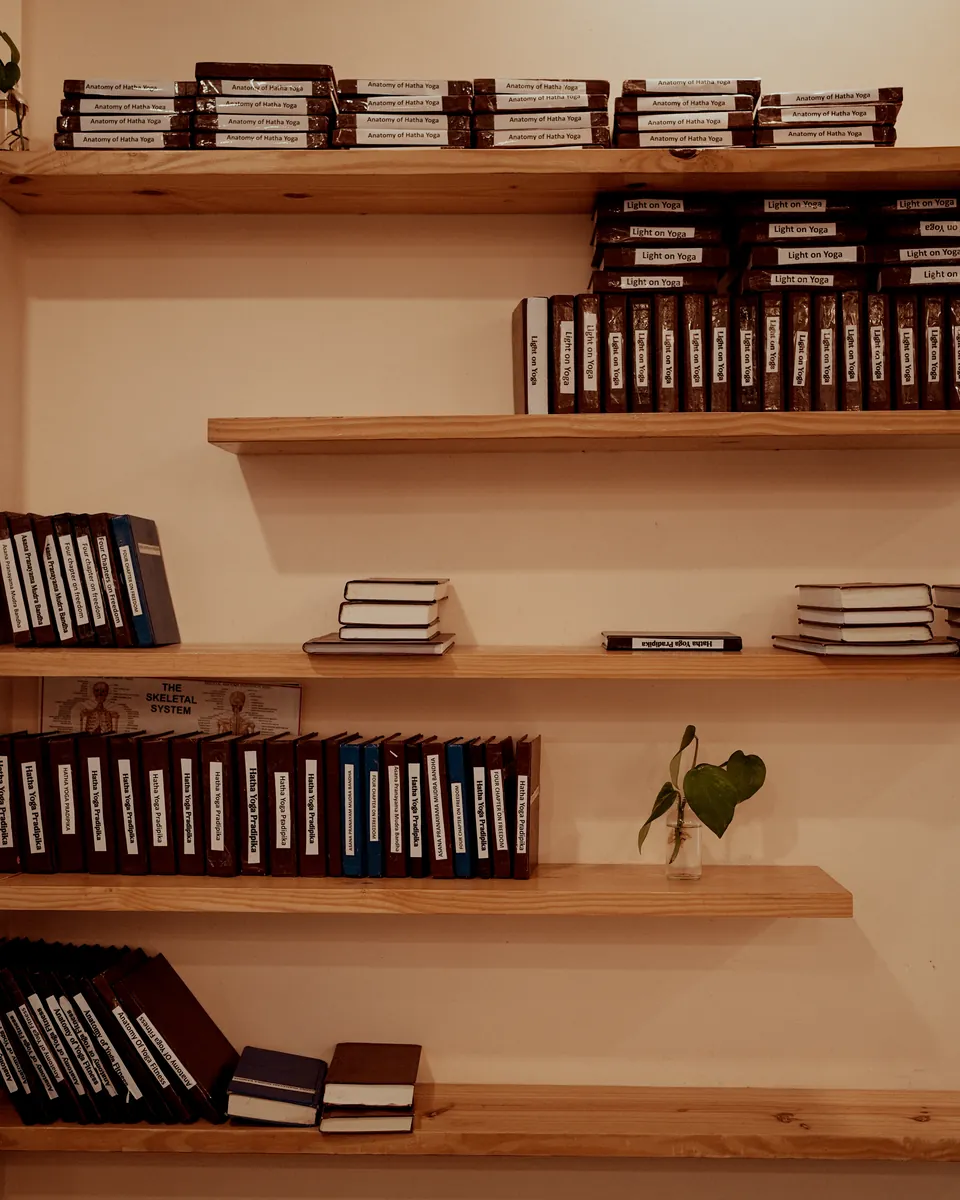
Shelves of bound yoga texts, including Light on Yoga, in the ashram library in Rishikesh
The ashram library

The ashram library

The books on our shelves

The texts of these masters are kept in the ashram library, for reading between classes and for the questions that follow you out of the philosophy hall.

  1. Bhagavad GitaMaharishi Vyasa
  2. Yoga Sutras of PatanjaliMaharishi Patanjali
  3. Hatha Yoga PradipikaSwami Swatmarama
  4. Raja Yoga (1896)Swami Vivekananda
  5. The Yoga of SynthesisSwami Sivananda Saraswati
  6. Light on Yoga (1966)B.K.S. Iyengar

Questions

Studying the spiritual gurus of India on a yoga course

There is no single list, and India has many great teachers. For a yoga student, the masters on this page are a good place to start: Vyasa for the Bhagavad Gita, Patanjali for the Yoga Sutras, Swatmarama for the Hatha Yoga Pradipika, and three modern masters, Swami Vivekananda, Swami Sivananda and B.K.S. Iyengar, who carried those teachings to the world.

No. Each text is introduced in class, starting from the basics. If you would like to begin early, an English translation of the Yoga Sutras is the best first step.

Two are by masters on this page: Swami Vivekananda's Raja Yoga and B.K.S. Iyengar's Light on the Yoga Sutras of Patanjali. Our faculty will suggest others during the course.

It grew from Indian spiritual traditions, and we teach it as philosophy and history. Students of every faith, and of none, study it with us. You are welcome to join the chanting and ceremonies, and no one is asked to adopt a religion.

You will learn the Sanskrit terms used in yoga, the names of the asanas, and how to pronounce and chant key sutras and mantras. You do not need to know any Sanskrit before you arrive.

Hatha Yoga in Rishikesh, since 2005

Study the masters where their teachings live

Choose a course, or ask our yoga program counsellor how philosophy is taught at the ashram.

Book now Counsellor